April 24, 2011

Beautiful Blackbird


Title:  Beautiful Blackbird
Ashley Bryan (Author and Illustrator)
Click the Amazon link to purchase: 
Beautiful Blackbird (Coretta Scott King Illustrator Award Winner)

Comprehension Strategy:          Synthesizing              
Art Modalities: Creative Movement, Visual Art

Summary: In a story of the Ila people, the colorful birds of Africa ask Blackbird, whom they think is the most beautiful of birds, to decorate them with some of his “blackening brew.” (Summary from the book.)

Materials:
Beautiful Blackbird
black tempera paint
feathers
various colors of construction paper
simple bird pattern

Lesson:
Synthesis takes place when readers’ thinking changes. Their thinking evolves. They infer meanings beyond the story line. They recognize themes.
Read aloud Beautiful Blackbird. To help your students recognize the themes, you might want to discuss the following lines from the story:

“Color on the outside is not what’s on the inside. You don’t act like me. You don’t eat like me. You don’t get down in the groove and move your feet like me.”

“We’ll see the difference a touch of black can make. Just remember, whatever I do, I’ll be me and you’ll be you.”

Extend the students’ understanding of the story by encouraging creative movement. Gather students in an open space such a gym. Reread the story. Have students move “with a flip flop flapping of their wings” and a “stirring, whirring of the air” as you read the description of the “Beak and Wing Dance” and the “Show Claws Slide.”

To prepare for a visual-art extension, mix some “blackening brew” (black paint) in a “medicine gourd.”
To make a bird, each child traces and then cuts out a simple bird shape from construction paper. She then uses a feather to paint on black accents. Display the birds on a yellow background along with the following poem from the story.

“Our colors sport a brand-new look,
A touch of black was all it took.
Oh beautiful black, uh-huh, uh-huh
Black is beautiful, UH-HUH!”

 "Meet" Ashley Bryan at Reading Rockets.

More from Ashley Bryan, Uh-huh!


April 8, 2011

Bubble Gum, Bubble Gum


Title: Bubble Gum, Bubble Gum
Lisa Wheeler (Author)
Laura Huliska-Beith (Illustrator)

Comprehension Strategy: Visualizing               
Art Modality: Drama

Summary:
After a variety of animals get stuck one by one in bubble gum melting in the road, they must survive encounters with a big blue truck and a burly black bear. (Summary from book.)

Materials:
Bubble Gum, Bubble Gum
pink, plastic tablecloth cut into gum shape (see the cover of the book)
copies of the choral reading (for older readers)

Lesson:
Just when you need a lesson to liven things up, along comes a book like Bubble Gum, Bubble Gum—with ooey-chewy words and an icky-sticky story to get stuck on! After reading the story aloud, I introduced my group to a choral reading of the text. I can’t post the whole chant, but here’s a sneak peak to help you get the idea. (If you drop me an email, I’ll send you the entire choral reading. Just title your message “Bubble Gum” and send to jaynestamp@cox.net.)

Teacher:
Bubble gum, bubble gum,
Chewy-gooey bubble gum,
Icky-sticky bubble gum
Melting in the road.

Group 1:
Along comes a toad...
A fine, fat toad,
A fine, fat, wild
Splat!
Wart-backed toad.

All:
Ew! Yuck! The toad got stuck!

Reading this rhyme is kind of like chewing gum, the more you read, the smoother it gets. For even more fun, try this drama extension. In advance, cut an expensive, pink plastic tablecloth (available from dollar stores) into a bubble-gum shape. Place the shape on the floor of an open area. Select volunteers to be the toad, shrew, goose, bee, crow, black bear and hen. Ask these students to visualize how the animals would move before and after getting stuck in the mud. Read aloud the story as the students pretend to be stuck in the “gum.” When you read the part where the animals blow the bubble, have the students lift the tablecloth in the air as they would a parachute. “Bubble gum, bubble gum, light and lifty bubble gum!”

The toad and the bad-mood shrew are stuck!


They chewed and they chewed....


Along comes a big-bottomed bear!


Find out more about the author:


March 29, 2011

Yesterday I Had the Blues


Title: Yesterday I Had the Blues
Jeron Ashford Frame (Author), 
R. Gregory Christie (Illustrator)

Comprehension Strategy: Inferring                   
Art Modality: Poetry


Summary: Ever had the blues? Yesterday one boy had them bad—not just the ordinary blues, the "deep down in my shoes" blues, the "go away Mr. Sun quit smilin' at me" blues. But today he's traded in those blues for greens, the "runnin' my hands along the hedges" greens, the kind of greens that make him want to be SOMEBODY. With text that begs to be read aloud, and bold, colorful paintings, this book will have readers big and small pondering the spectrum of moods and how they can change from day to day. (Summary from Random House, Inc.)

Materials:
Yesterday I Had the Blues
chart paper
markers

Lesson:
Trying to teach your students to infer? Don’t let it give you the blues! First, read aloud this jazzy story. Follow up the reading with a discussion about each character’s emotions. Encourage students to use their background knowledge, the text clues, and the illustrations to explain the reasons for the feelings. Here’s the chart we made from our class discussion:


On another day, reread the story and review the chart. Use this poetry frame to encourage your students to think about their own feelings.

Yesterday I had the _________________.
The ________________________________________.

Today I got the ___________________.
The ________________________________________.

Tomorrow I hope I have the _____________.
The ________________________________________.

This poetry by my second graders gives me the pinks...the oh-so-happy, lips smilin’, tickled-pink pinks!


Do your kids have the blues? Let them watch this animated clip of the story. They’re sure to want to read along, and before you know it they’ll feel golden!

March 8, 2011

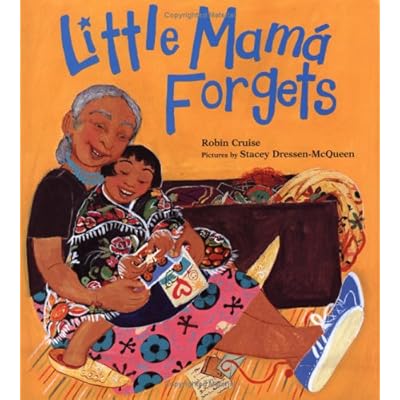
Little Mama Forgets


Title:  Little Mama Forgets


Robin Cruise (author), Stacey Dressen-McQueen (Illustrator)

Comprehension Strategy: Synthesizing                                   
Art Modality:  Poetry

Summary:
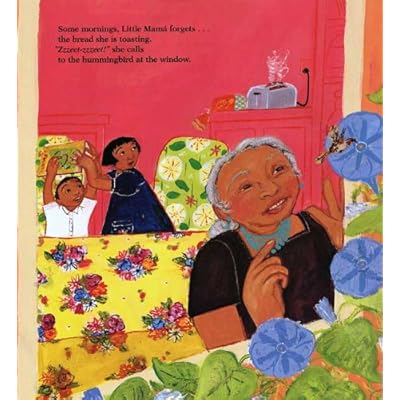
Although her Mexican-American grandmother now forgets many things, Lucy finds that she still remembers the things that are important to the two of them. (Summary from the book.)

Materials:
Little Mama Forgets
chart paper, markers

Lesson:
Your students are sure to remember this poetry lessons that is a follow-up for Little Mama Forgets. After reading the story aloud, invite the students to think about the things that Mama forgets and the things that she remembers. On a chart, list the things that Lucy, the granddaughter who tells the story, says that Mama forgets. Then list the things that Lucy says that Mama remembers. What do the things have in common? What types of things are on the "forgets" list as compared to the types of things on the "remembers" list? You may wish to lead students in a discussion about the relationship between Lucy and her grandmother. In addition, you might also want to discuss the things that Mama remembers from her youth and about her culture.

To prepare your students for a poetry follow-up, ask them to think about what they might remember when they grow old. Who are the people that are most important to them? What things do they do with those special people? What celebrations are important to their families? What are their favorite things to do? Is it easier to remember things that you have strong feelings about? Provide the following poetry frame to assist your students in writing free-verse poetry.

I might forget…
I could forget…
but I'll always remember…


Here are some sweet poems that my second graders wrote!


Mom        (by James, age 8)
I might forget what she wore.
I could forget when she fell down the steps.
But I'll always remember how she makes me cinnamon rolls.


Great Grandpa    (by Madeline, age 8)
I might forget how he sounded.
I could forget how he used to play the piano.
But I'll always remember when he held me in the hospital.


My Sister, Stella    (by Marlie, age 8)
I might forget that she slaps me in the eye.
I could forget when she first punched me.
But I'll always remember her smile and when she was born.


Grandma      (by Jake, age 8)
I might forget what she wore.
I might forget what she sounded like.
But I'll always remember that it may have been the loveliest voice anyone heard.


Learn more about the author: http://robincruise.com


February 4, 2011

The Boy Who Grew Flowers


Title: The Boy Who Grew Flowers
Jennifer Wojtowicz (author)
Steve Adams (Illustrator)
(To purchase, use the Barefoot Books link on the right.)

Comprehension Strategies: Questioning, Inferring       
Art Modalities: Drama, Visual Art

Summary: Shunned at school because he sprouts flowers every full moon, Rink Bowagon makes a special pair of shoes for a classmate who is able to appreciate his unique abilities.
(Summary from book.)

Materials:
The Boy Who Grew Flowers
Class supply of white art paper, pencils, permanent black markers, watercolor paints

Lesson:
Introduce the book by inviting the students to look closely at the cover. What questions do they have about the story just from looking at the illustration? You might want to lead the students in asking questions such as:
Why is the boy holding flowers?
Why is the boy holding green shoes?
Is it important that there is a full moon?
How did the boy grow flowers?
Why is his house on a hill?

Next read aloud the first several pages of the text. Stop after you read Angelina's question to the class, "Why won't anyone talk to him?" Since the "question rattled in their minds," allow students time to think about, discuss, or journal their own answer to this question. Then invite students to pretend that they are Rink's classmates. Have students answer Angelina's question out loud.

For Older Students:
Reread the part of the story that explains that the Bowagons lived on Lonesome Mountain. Remind the students that the "townspeople argued as to whether it was because they were such strange folk that they lived there, or whether it was because they lived there that they were such strange folk." After discussing these two ideas, invite students to divide into two groups of townspeople based on which idea they agree with. Encourage the two groups of townspeople to "argue" about which opinion is true.

Visual Arts Follow-up:
Invite students to discuss why Rink sprouts flowers when it is not a full moon. Then invite them to close their eyes and think thoughts so pleasant, that they, too, could spout  flowers. Next lead students through the process of drawing a self portrait. Direct the children to draw flowers sprouting from their heads. A sentence about their happy thought can also be added to the paper. Each child should draw his portrait with pencil, trace the lines with permanent marker, and then watercolor paint the image.


Personal note: 
My students' discussions made me so happy, I thought I would sprout flowers from my head! Also, I found lesson plans about drawing portraits on www.artsonia.com. (Just create an account and then login to see lesson plans.) I believe that seeing the images in lesson #2711 really helped my artists. Enjoy!


January 28, 2011

Mind Your Manners, B.B. Wolf


Title:  Mind Your Manners, B.B. Wolf
Judy Sierra (Author), Jotto Seibold (Illustrator)
Comprehension Strategy: Making Connections (using Prior Knowledge)                       
Art Modalities:  drama, music

Summary:
When B. B. Wolf, who now lives in the Villain Villa Retirement Residence, is invited to the library for a storybook tea, he is careful to follow the advice of this crocodile friend and impresses everyone with how polite he can be. (Summary from book.)

Materials:
Mind Your Manners, B. B. Wolf
optional: The Three Little Pigs
Little Red Riding Hood
The Gingerbread Man
(Choose versions of these stories most appropriate for the listening skills of your students.)

Lesson:
Who's afraid of the Big Bad Wolf? None of your students will be scared of B. B. Wolf—or good manners—after listening to this story about his excellent etiquette lesson. To prepare students to make text-to-text connections, you might want to first read several classic tales of wolf mischief, such as The Three Little Pigs and Little Red Riding Hood. Even though it is most often a fox and not a wolf that is the danger in The Gingerbread Man, you might also want to read this story because a gingerbread man is featured in the illustrations of this book. Finally, you might also wish to discuss why Little Bo Peep, in the traditional nursery rhyme, would need to be afraid of wolves since they were a danger to her sheep.

Prior to reading the story, invite students to choose characters from these classic tales to portray. Options include any of the three pigs, Little Red Riding Hood, her grandmother, the woodsman, and the Gingerbread Man. Group students by their chosen characters, or have them label themselves with nametags. Using a toy microphone, and perhaps even a video camera, interview the characters to find out what they already know about our main character: B. B. Wolf. How have their previous experiences with the wolf affected their opinion of him? What words best describe his personality? What are his motives in most stories? What advice would these characters give to other storybook characters about the wolf?

In the story, B. B. Wolf makes up a song to help himself remember the etiquette advice provided by his friend the crocodile. Following your read aloud of the story, invite students to help you create a tune for the crocodile's advice. Perhaps you could try the words to the tune of popular songs that the students already know. Or challenge older students to create their own tunes to perform for the class. If desired, sing the text to the tune of "Bingo."
Sip your tea and never slurp,
Say, "Excuse me" if you burp.
Use good manners, please!
When you go to the library.

Smile and have a lot of fun,
but don't go biting anyone!
Use good manners, please!
When you go to the library.


For more information about the author, visit: 
http://www.judysierra.net/index.htm